
About
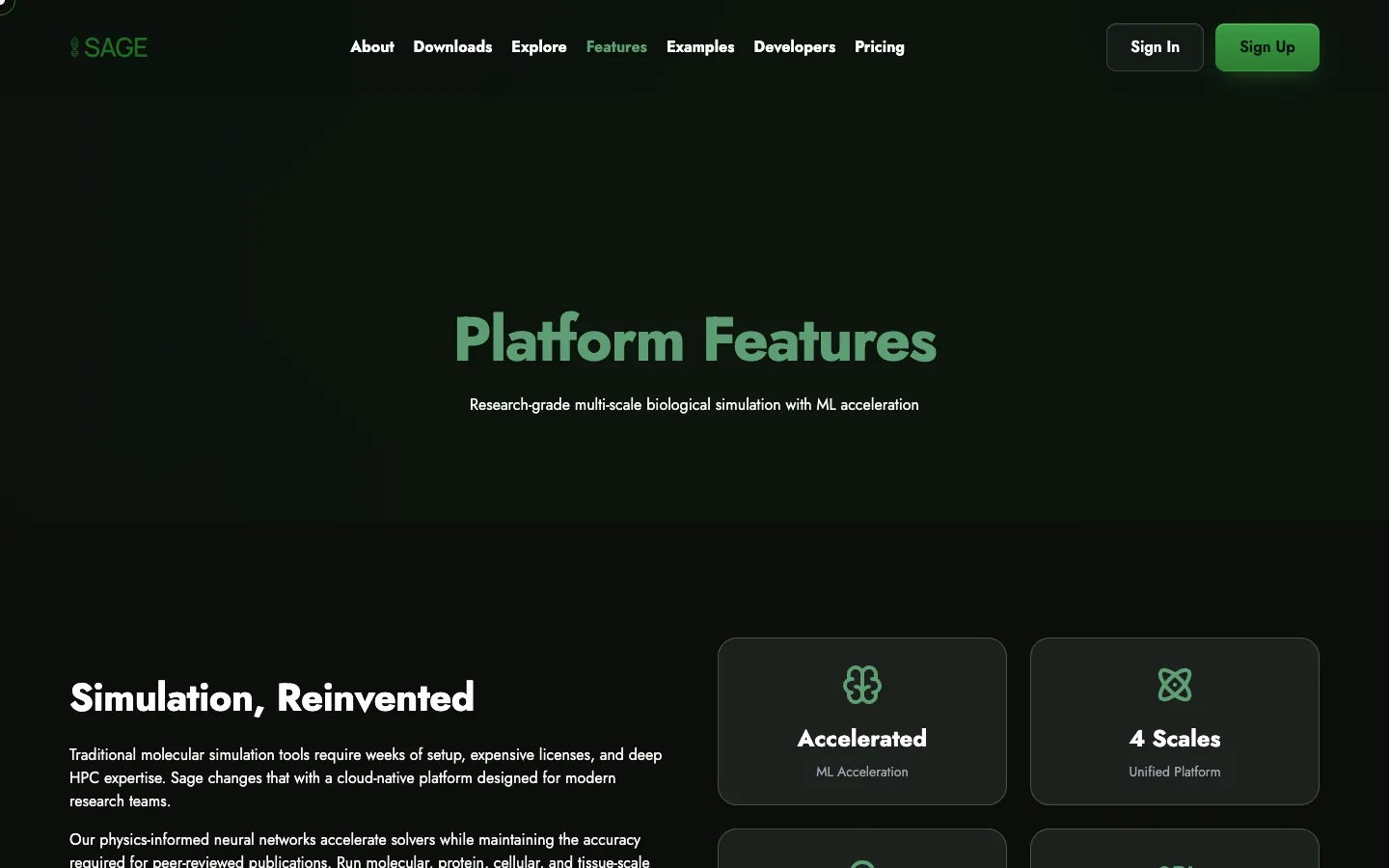
Sage is a cloud platform for biological simulation across four scales: molecular, protein, cellular and tissue. Researchers load a structure from RCSB or draft one from a natural-language prompt, choose a force field and conditions, and watch trajectories unfold in a live 3D viewer.
Physics-informed neural networks learn from molecular dynamics runs to speed up simulation while keeping biochemical constraints. Sage describes itself as the step after structure prediction: it takes a known structure and simulates how it moves, binds and reacts.
The Optimization Studio runs target-driven campaigns that tune a structure toward properties such as binding affinity and stability. The site presents fully de novo design from target specifications as the broader vision.
Teams can scrub and replay trajectories, review per-residue analytics, share interactive results and automate work through a REST API with Python and JavaScript clients. The public demo uses an approximate AI surrogate on sample complexes to estimate binding affinity.
Butts Studios designed the landing site.
Details
- What we made
- Landing site
- Captured
- October 2026
Gallery
3 images. Tap any one to see it full size.
Articles & notes
Published pages from Sage: write-ups, docs and data. Each opens on its own site.
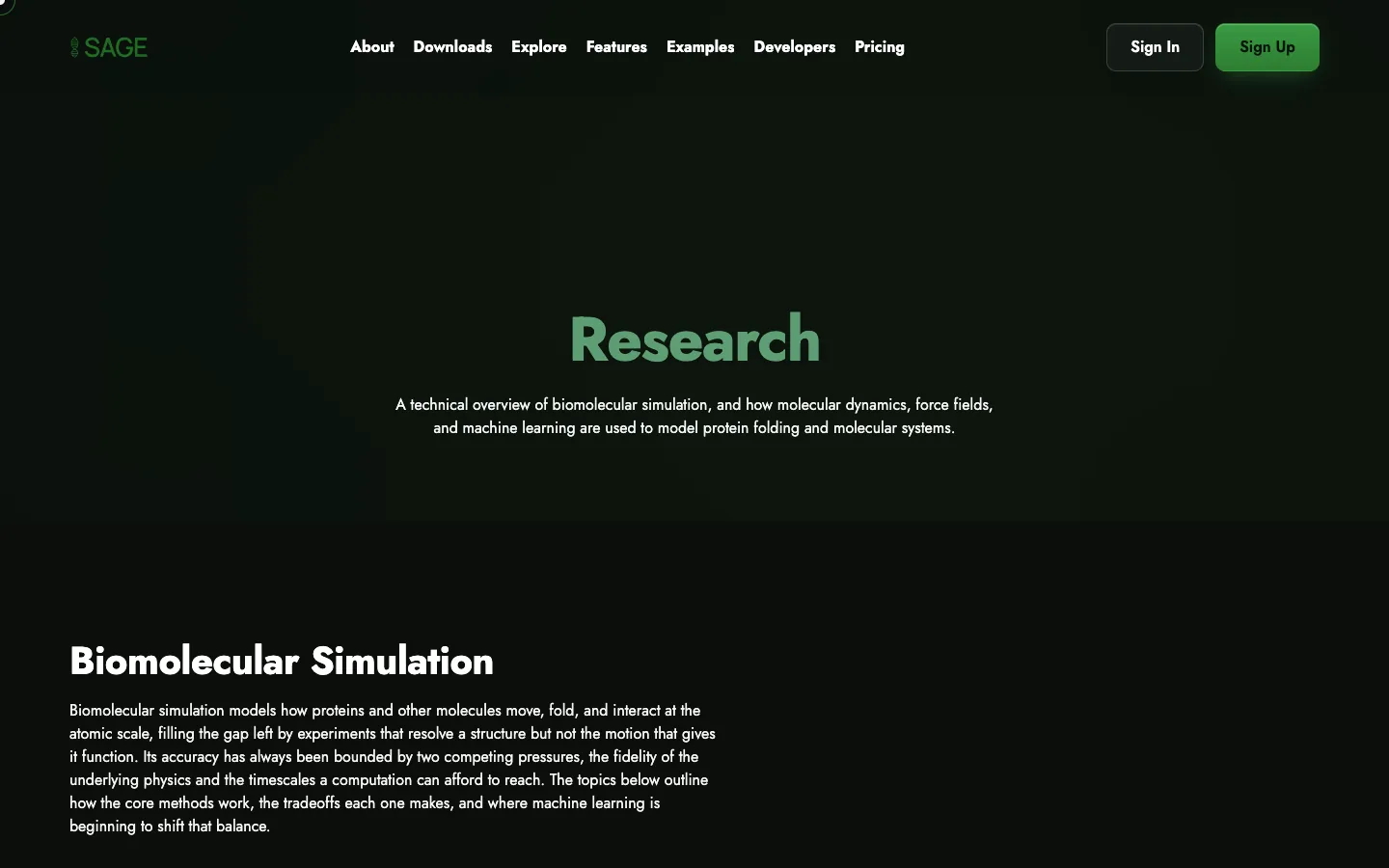
- sagesimulation.com ↗ResearchTechnical overview of molecular dynamics, force fields, ML potentials and enhanced sampling
- sagesimulation.com ↗BenchmarkingOpen benchmark defining task, convention and scoring for molecular force-field surrogates
- sagesimulation.com ↗ModelsNeural-net surrogate models with model cards, weights and an inference package
- sagesimulation.com ↗Screen a binding affinity in millisecondsLive demo estimating drug and protein binding affinity on sample complexes
- sagesimulation.com ↗A machine-learned force field can pass the benchmark and still fail the simulationWhy benchmark accuracy and stable simulation behavior can diverge for ML force fields
- sagesimulation.com ↗How molecular simulation learned to watch a protein moveA short history of molecular dynamics, from early methods to the Nobel