Farad
Product · Landing site
Defensive cyber simulation for training and benchmarking autonomous defender agents, building toward privacy-preserving collaborative defense.
Visit ↗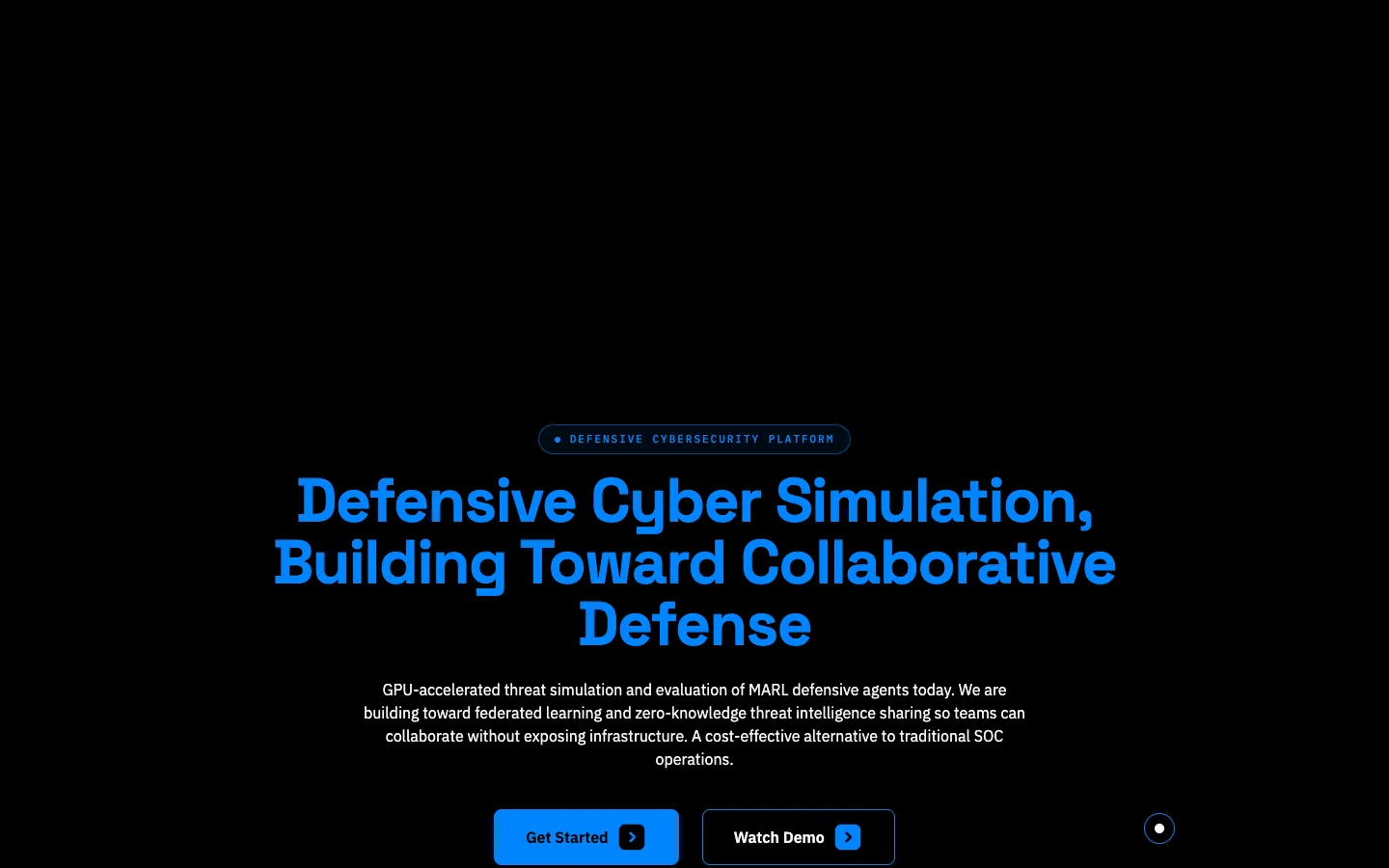
About
Farad is a defensive cybersecurity platform built around simulation. Today it trains and evaluates cooperative multi-agent reinforcement learning defenders against adversaries scripted over a modeled network.
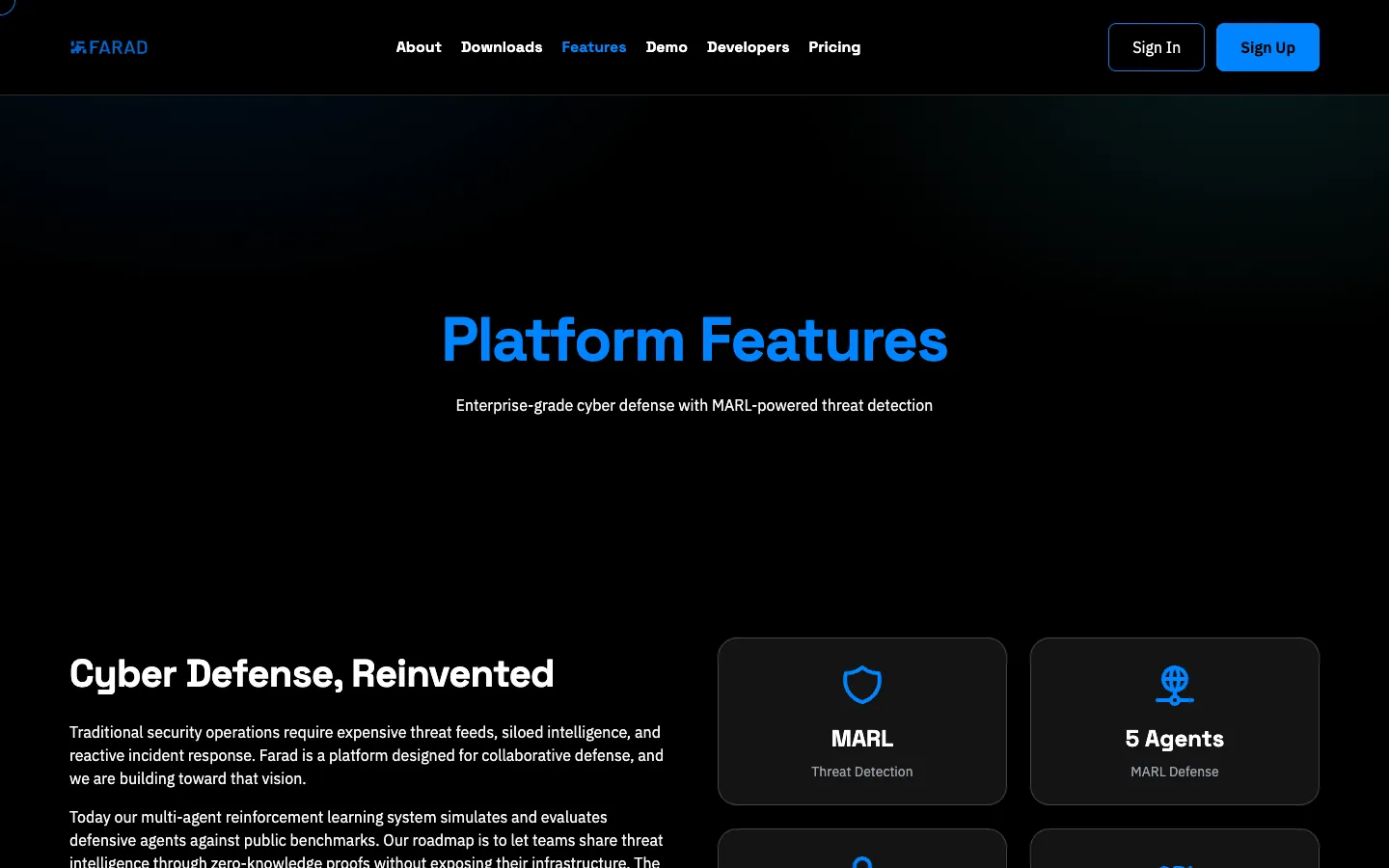
Five specialized agents cover detection, response, hardening, forensics and threat hunting. Benchmark reports reference MITRE-aligned threats and public references such as CAGE-4, and a replayable spatial view shows what a defender did and why.
The longer-term aim is collaborative defense through federated learning and zero-knowledge proofs, so organizations can share threat intelligence while keeping their infrastructure private. The site states that the proof circuits are implemented and that the cross-organization exchange is on the roadmap.
The public demo uses a trained detector to read the stage and severity of synthetic attack scenarios as a fast estimate.
Butts Studios designed the landing site.
Details
- What we made
- Landing site
- Captured
- October 2026
Gallery
5 images. Tap any one to see it full size.

Articles & notes
Published pages from Farad: write-ups, docs and data. Each opens on its own site.
- faraddefense.com ↗ResearchOverview of multi-agent RL, red and blue team simulation, and privacy-preserving learning
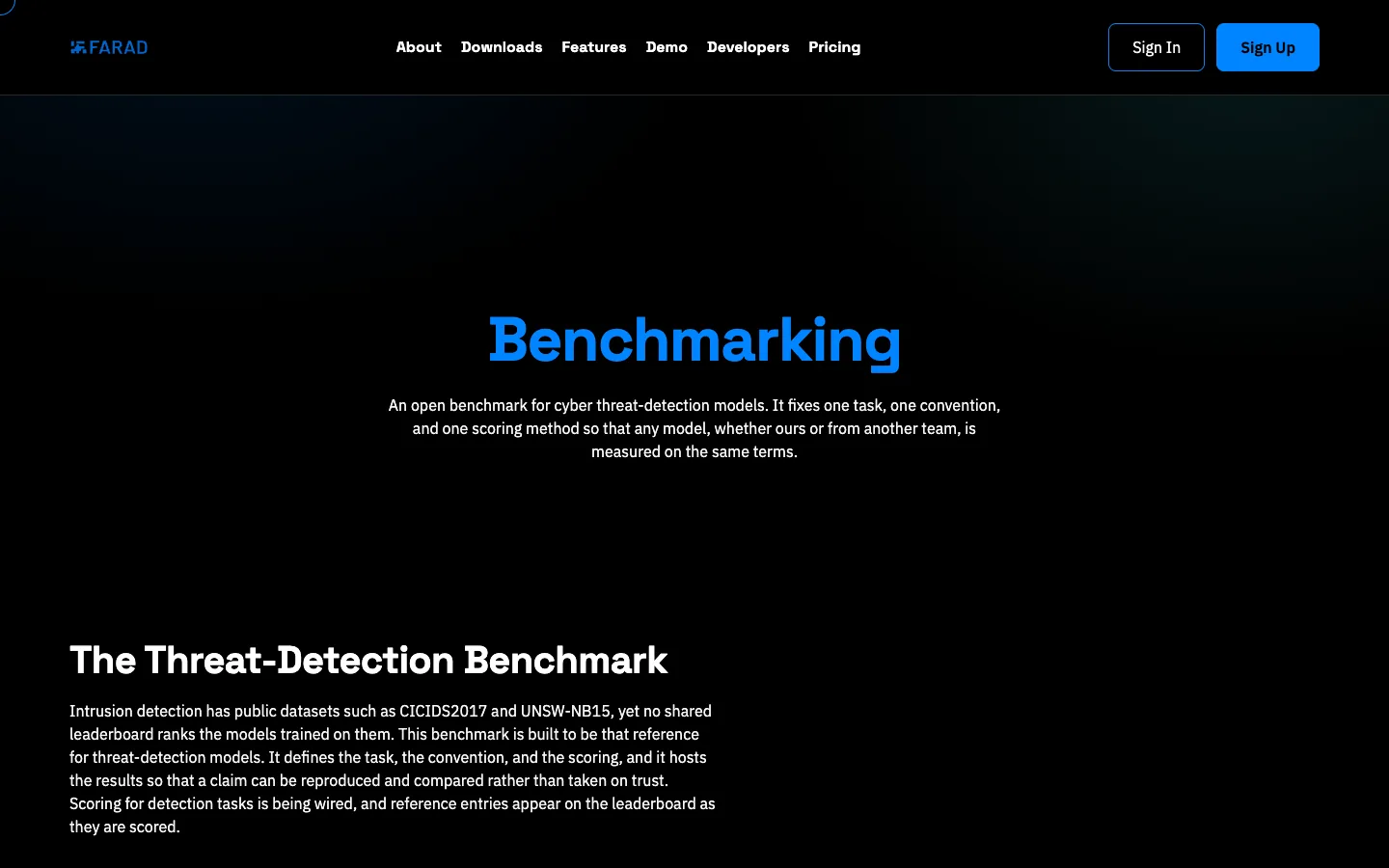
- faraddefense.com ↗BenchmarkingOpen threat-detection benchmark with fixed task, metrics and held-out scoring
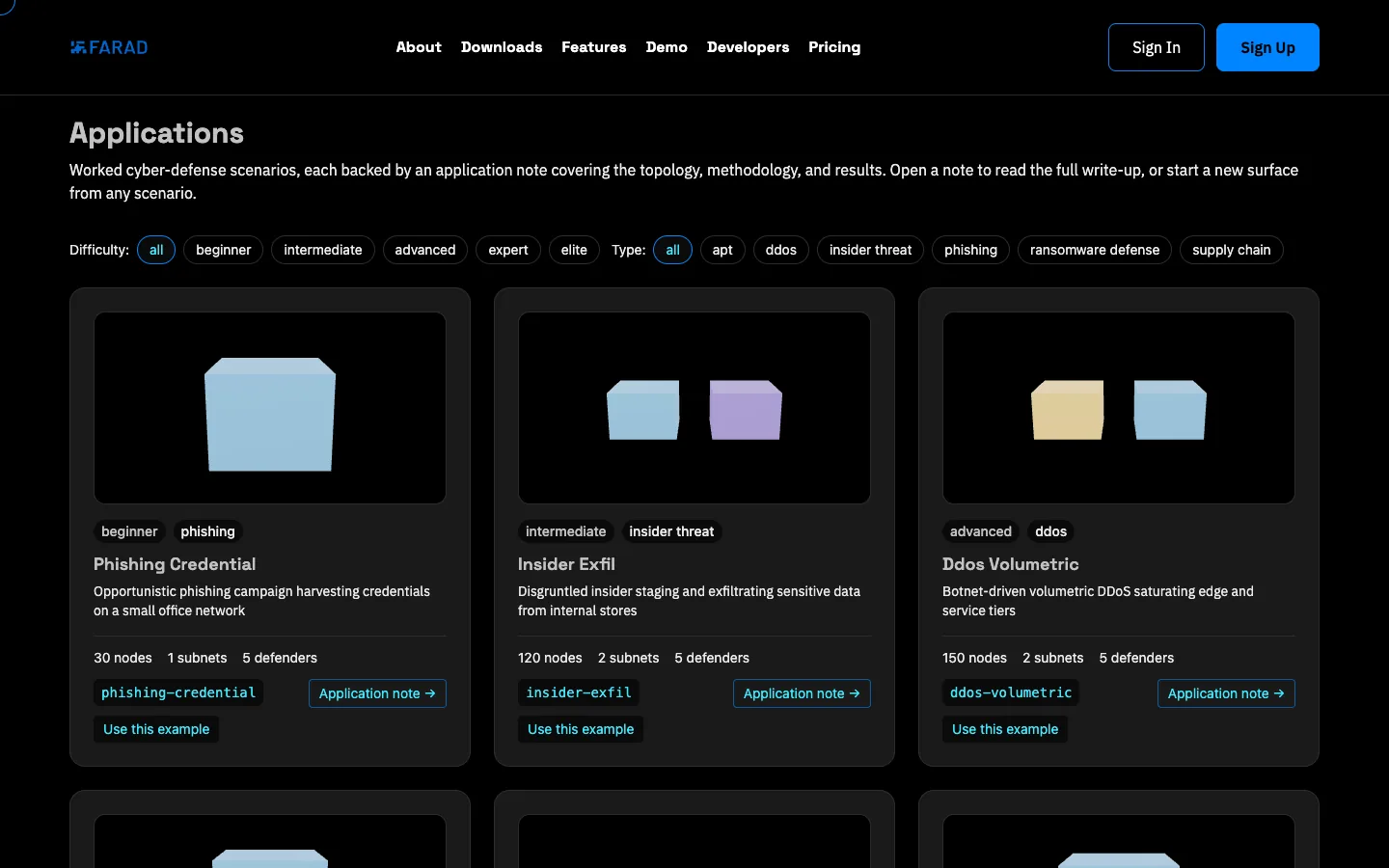
- faraddefense.com ↗ApplicationsWorked cyber-defense scenarios with topology, difficulty and application notes
- faraddefense.com ↗See a threat's stage in secondsDemo reading threat profile and kill chain stage from synthetic scenarios
- faraddefense.com ↗A shared gym gave autonomous cyber defense a place to practiceHow the CybORG environment pairs simulation and emulation for defender training
- faraddefense.com ↗A defense agent that wins in simulation still has to prove it on a real networkOn the gap between simulated defense results and real network performance