Tiffany
Product · Landing site
Central monitoring for research infrastructure: streaming metrics ingestion, time-series analytics and live dashboards in one platform.
Visit ↗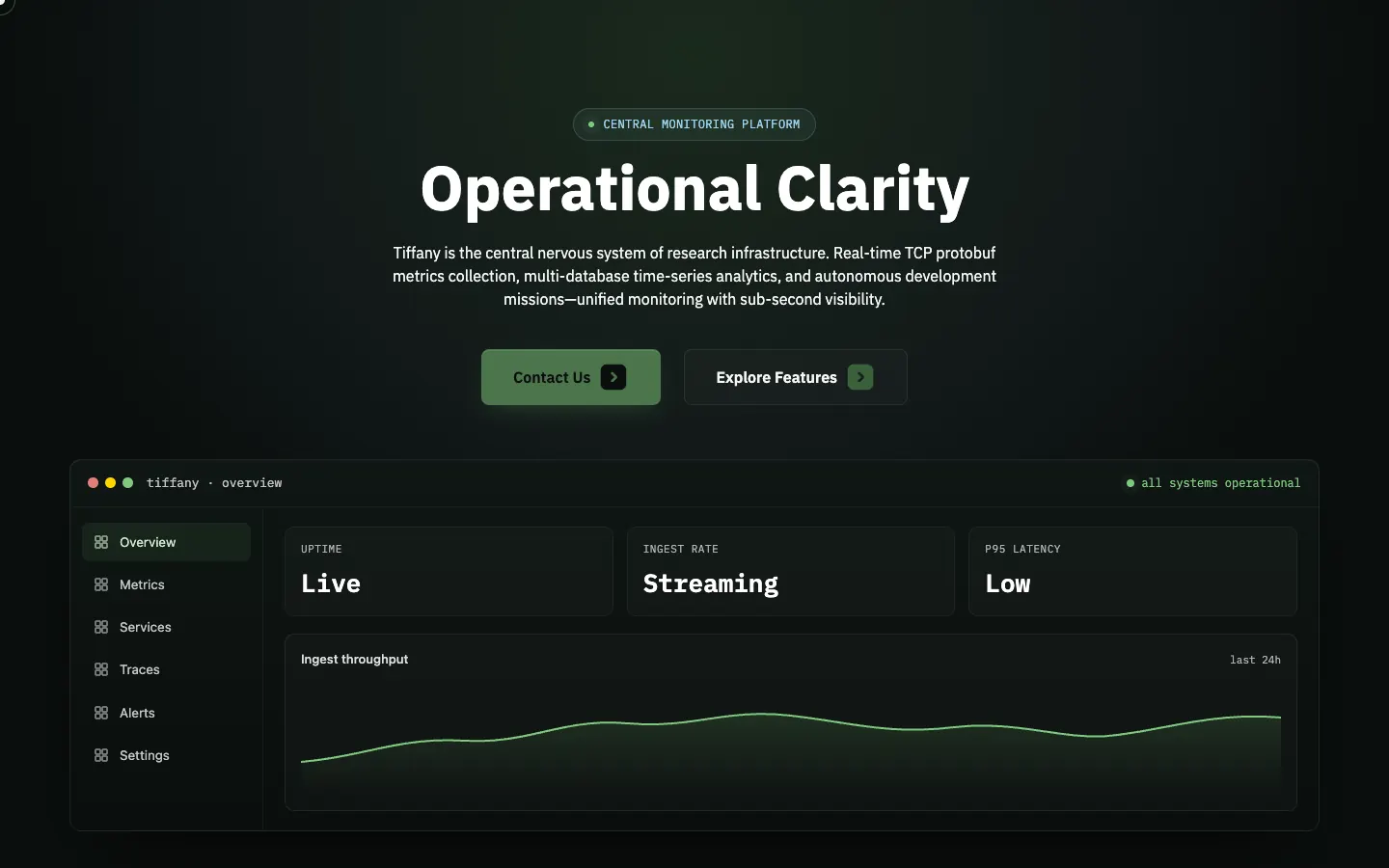
About
Tiffany is a central monitoring platform for research infrastructure. It ingests metrics over a binary TCP protobuf stream, as well as length-prefixed JSON and StatsD over UDP, and shows them in live dashboards with drill-down views.
Storage is split by workload: PostgreSQL for transactional data, TimescaleDB for time series with continuous aggregation, and Redis for caching and sessions. Tiffany reports its own health through the same pipeline it uses for every other service.
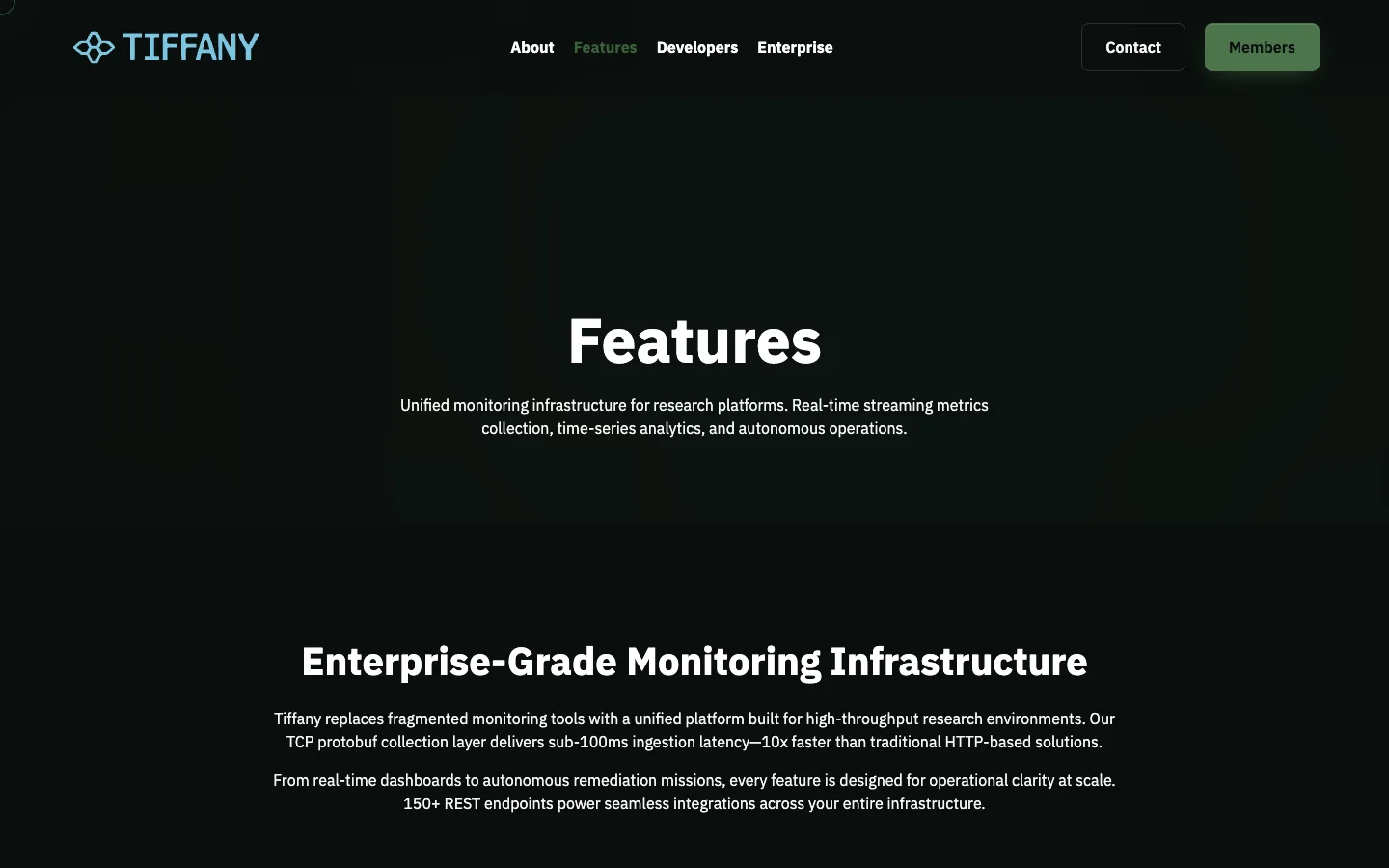
A REST API with OpenAPI documentation, a CLI for operations tasks, an operator console for entitlements and LLM cost tracking, and an autonomous missions engine for routine development work complete the platform. It is offered under a one-time enterprise license with self-hosted, on-premise and hybrid deployment.
Butts Studios designed the landing site.
Details
- What we made
- Landing site
- Live
- tiffanyapp.com ↗
- Captured
- October 2026
Gallery
3 images. Tap any one to see it full size.

Articles & notes
Published pages from Tiffany: write-ups, docs and data. Each opens on its own site.
- tiffanyapp.com ↗Observing a fleet of independent services through one pipelineHow a fleet-wide telemetry pipeline handles ingestion, storage and query cost
- tiffanyapp.com ↗Observability is consolidating around a single open standardHow observability data collection is converging on one open format
- tiffanyapp.com ↗The benchmarks behind anomaly detection needed fixing firstWhy anomaly detection benchmarks were flawed and how they were corrected
- tiffanyapp.com ↗Forecasting turns autoscaling from reactive to proactiveUsing load forecasts to scale services ahead of demand
- tiffanyapp.com ↗Error budgets turn reliability into a number teams can spendHow SLOs and error budgets make reliability a measurable target
- tiffanyapp.com ↗Alerting on burn rate instead of raw thresholdsWhy burn-rate alerting catches SLO risk better than fixed thresholds